
Kampala, Uganda — June 2026
The Central Laboratory and Animal Research Facility (CLARF) hosted a delegation of scientists from the Uganda Cancer Institute (UCI) for a landmark meeting aimed at establishing a formal partnership in preclinical research, quality assurance, and scientific validation of locally developed therapeutic products.
The engagement marks a significant step in CLARF’s mission to position itself not merely as a research centre, but as a full-service consortium and enterprise supporting scientists across Uganda and the wider region.
A Meeting of Giants in Cancer Research
Opening the meeting, the CLARF leadership welcomed the UCI team, describing the Institute as a leading authority in cancer research in the region. UCI had formally reached out to CLARF to explore collaboration, a move warmly received as a model of the synergistic, ecosystem-based approach that both institutions champion.
CLARF presented its structure and service domains to the visiting team, which span:
- Preclinical (pre-industrial) trials — covering both human and veterinary research
- Veterinary clinical (industrial) trials
- Scientific and transgenic animal model production
- Quality Assurance, Standards and Accreditation (QASA) — developing SOPs and meeting local and international accreditation
- Sustainable partnerships and capacity building
- Support services
UCI’s Centre for Natural Therapeutics
The UCI delegation introduced the Uganda Cancer Institute Centre for Natural Therapeutics, an initiative conceived around five years ago to scientifically validate natural and herbal therapies used alongside conventional cancer treatment. Supported by a grant from Science, Technology and Innovation (STI), the Centre is establishing a mini-GMP facility for plant processing, extraction, compounding and packaging, alongside an in-vitro platform leveraging UCI’s existing accredited laboratories and biobanking facility.
A central focus of the discussion was ImmunoNat, a product formulated to address chemotherapy-induced neutropenia, a condition in which cancer patients suffer dangerously low neutrophil counts following chemotherapy, leaving them highly vulnerable to infection and contributing significantly to mortality at the Institute. ImmunoNut is now set to undergo rigorous scientific validation, including in-vivo studies covering acute, sub-acute and chronic toxicity as well as efficacy.
The UCI team also highlighted a pipeline of additional innovative prototypes targeting prostate cancer, breast cancer chemoprevention and treatment, and opioid-induced constipation in patients on pain management.
A Partnership Endorsed
Following presentations and contributions from CLARF’s team leaders, the meeting unanimously passed a motion to establish the CLARF–UCI partnership for bio-innovation, prototype development, quality assurance and scientific validation, beginning with the ImmunoNat products and extending to other products UCI will bring on board.
CLARF leaders emphasised that the collaboration would go well beyond laboratory work. The CLARF consortium also offers:
- Intellectual property (IP) protection for products
- Business development and idea-to-market support
- Commercialisation strategy
- Joint capacity building and training of the next generation of scientists
Representatives from STI, the venture’s sponsor, blessed the partnership and encouraged continued collaboration beyond STI-funded work. CLARF’s recent move towards the market including the sale of pathogen-free mice, was noted as an exciting milestone reflecting the facility’s shift “from a grant mentality to an enterprise mentality.”
Looking Ahead
Both parties agreed to fast-track a Memorandum of Understanding (MOU) to formalise the collaboration and enable work to begin without delay. The institutions resolved to move with urgency, draw clear timelines, and build a lasting consortium that contributes tangibly to Uganda’s economy, creating jobs, generating revenue, and reducing dependence on imported therapeutics through home-grown scientific innovation.
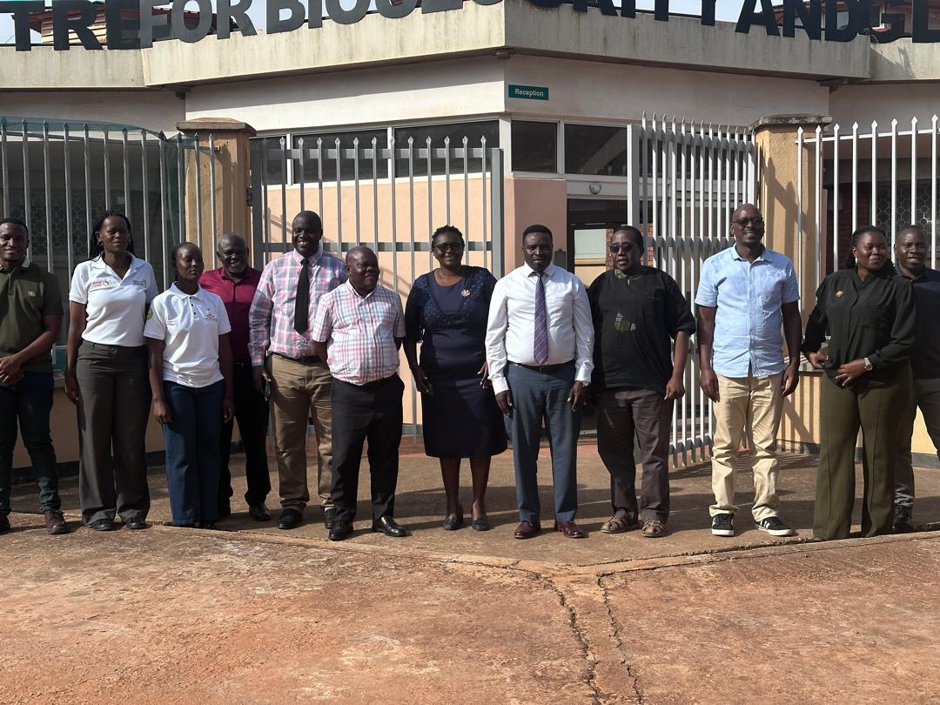
The meeting closed with remarks from the Deans and a group photograph, marking the beginning of what both teams described as a strong, forward-looking collaboration.
The Central Laboratory and Animal Research Facility (CLARF) is a central facility supporting scientists across Uganda and the region in preclinical research, scientific validation, and the journey from idea to market.